
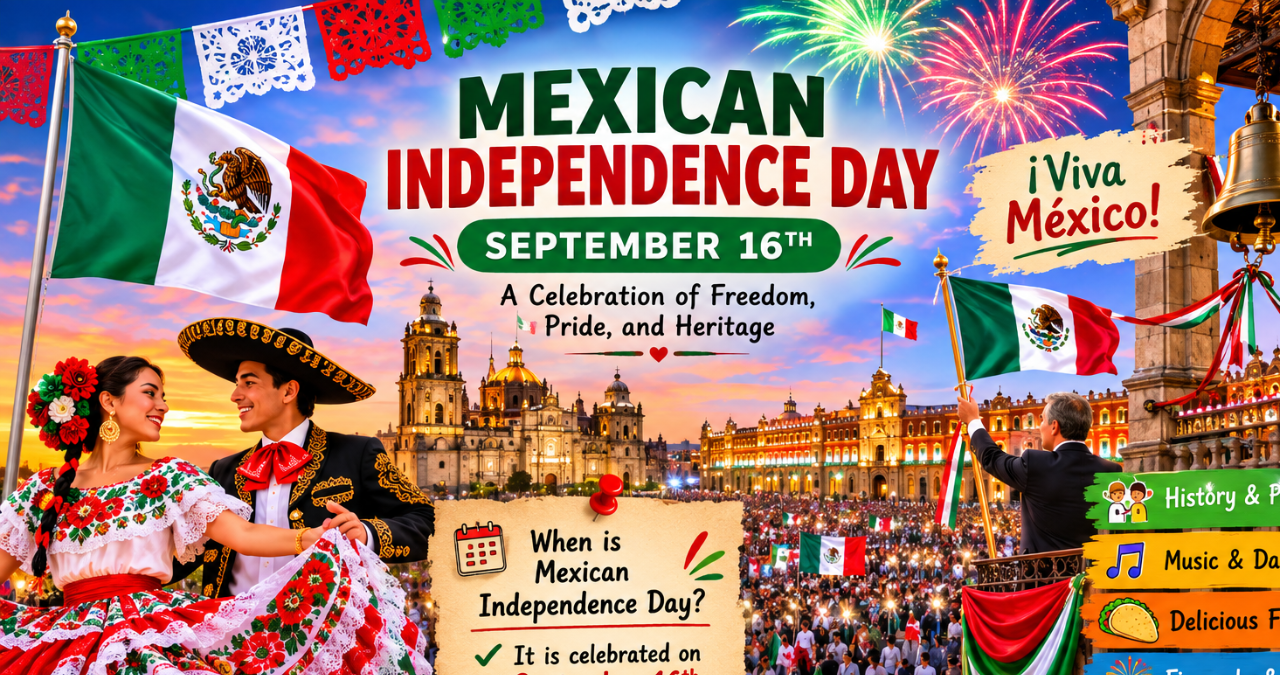
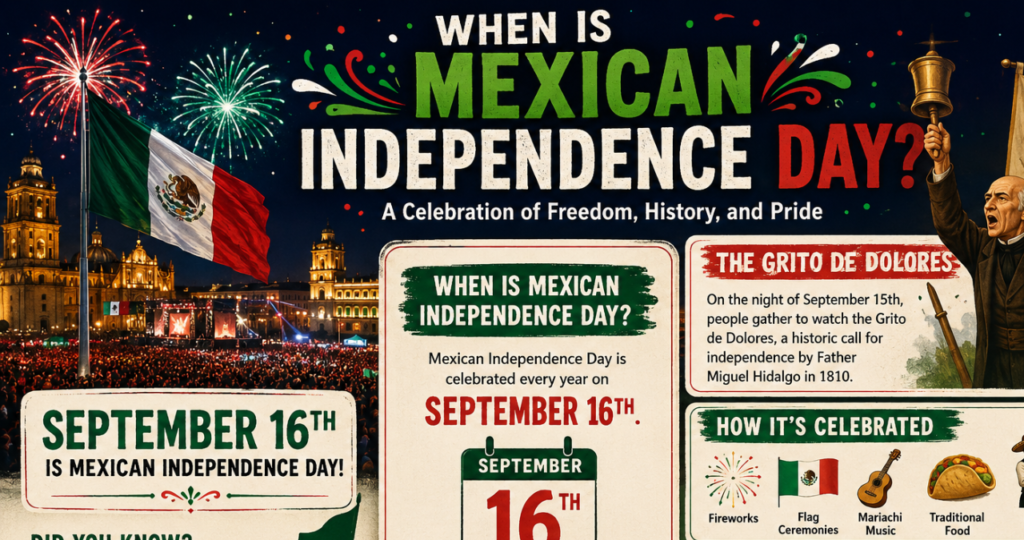
when is mexican independence day? Mexican Independence Day is celebrated every year on September sixteenth. It is one of Mexico’s most important national holidays and honors the beginning of Mexico’s struggle for independence from Spanish colonial rule. Although the official holiday is September sixteenth, many of the most exciting celebrations begin on the evening of September fifteenth, when people gather for the famous Grito de Dolores, or “Cry of Dolores.”
Mexican Independence Day is more than a date on a calendar. It is a celebration of history, courage, culture, family, music, food, and national pride. Across Mexico and in Mexican communities around the world, people mark the occasion with colorful decorations, fireworks, traditional meals, concerts, parades, and public ceremonies. Understanding the history behind the holiday makes the celebration even more meaningful.
When Is Mexican Independence Day Celebrated?
The answer to when is mexican independence day is simple: it is celebrated on September sixteenth every year. Unlike holidays that move from one day to another, Mexican Independence Day has a fixed date. The date remembers the beginning of the Mexican independence movement in the early nineteenth century.
The celebration, however, effectively begins on the night of September fifteenth. On that evening, people across Mexico prepare for a traditional ceremony known as the Grito de Dolores. The ceremony recalls the call for rebellion made by the priest Miguel Hidalgo y Costilla in the town of Dolores, in what is now the state of Guanajuato.
At around midnight in the early hours of September sixteenth in the original historical event, Hidalgo called on the people to rise against Spanish colonial authority. Today, the ceremony is recreated on September fifteenth, usually around eleven in the evening, by government leaders throughout Mexico.
So, while September sixteenth is Mexican Independence Day, September fifteenth is also a major part of the celebration.
Why Does Mexico Celebrate Independence Day?
Mexico celebrates Independence Day to remember the beginning of its long struggle to gain independence from Spain. For many generations, New Spain, as the territory was known under Spanish rule, was controlled by Spanish authorities.
Social and economic divisions were significant. People born in Spain generally enjoyed greater political influence than many people born in the Americas. Other groups faced additional social and economic restrictions. Over time, dissatisfaction grew, and ideas about freedom and self-government became more powerful.
The independence movement officially began in September of the early nineteenth century. It didn’t achieve independence immediately. Instead, Mexico experienced years of conflict and political change before independence was finally secured.
The holiday therefore represents both the beginning of the independence struggle and the eventual achievement of Mexican independence. It reminds people that major changes can take time and that history is often shaped by many individuals working toward a common goal.
The Story Behind the Grito de Dolores
One of the most important parts of Mexican Independence Day is the Grito de Dolores. The name comes from Dolores, the town where Miguel Hidalgo made his famous call for resistance.
Hidalgo was a Catholic priest who became an important leader of the early independence movement. According to the traditional account, he rang the church bell in Dolores and called local people together. He encouraged them to oppose Spanish colonial rule.
The exact words Hidalgo used have been debated by historians, and the modern ceremony isn’t a word-for-word reproduction of the original event. Nevertheless, the Grito has become a powerful national tradition.
Today, the president of Mexico gives a major Grito ceremony from the National Palace in Mexico City. Governors, mayors, and other officials conduct similar ceremonies in cities and towns across the country.
The ceremony usually includes:
- The ringing of a bell
- Shouts honoring Mexican independence
- Viva México! declarations
- Mexican flags
- Large public gatherings
- Music and performances
- Fireworks
- National celebrations
The atmosphere can be incredible. Crowds often respond loudly, proudly, and enthusiastically as the ceremony reaches its most exciting moment.
September Fifteenth and September Sixteenth: What’s the Difference?
It can be confusing to hear people talk about two dates during Mexican Independence celebrations. The easiest way to understand it is to remember that the two days are connected but have different roles.
| Date | Importance |
|---|---|
| September fifteenth | Evening celebrations and the Grito de Dolores ceremony |
| September sixteenth | Official Mexican Independence Day and national holiday |
| Historical independence period | A long struggle that eventually led to Mexico becoming independent from Spain |
On September fifteenth, families and communities often begin gathering in the evening. Public squares become lively, restaurants offer traditional dishes, and people wear clothing featuring the colors of the Mexican flag.
Later that night, the Grito ceremony takes place. Then the celebrations continue with fireworks, music, dancing, and food.
September sixteenth is the official holiday. Parades, military ceremonies, cultural events, and other activities may take place during the day.
In short, September fifteenth is the famous celebration night, while September sixteenth is the official Independence Day.
Who Was Miguel Hidalgo?
Miguel Hidalgo y Costilla is one of the central figures associated with Mexican independence. Born in the eighteenth century, Hidalgo became a Catholic priest and later emerged as a leader of the independence movement.
He believed that the people of New Spain deserved important political and social changes. His role in the beginning of the independence movement made him a lasting symbol of Mexican history.
Hidalgo’s leadership did not result in immediate independence. The early rebellion faced major challenges, and Hidalgo was eventually captured and executed. However, the movement continued after his death.
Other important leaders later played major roles in the struggle, including José María Morelos and Vicente Guerrero. Their efforts helped keep the independence movement alive.
Hidalgo is remembered today as the Father of Mexican Independence. His name appears on schools, streets, monuments, and public buildings throughout Mexico.
How Did Mexico Become Independent?
The road to Mexican independence was long and complicated. The movement that began with Hidalgo eventually developed into a larger political and military struggle.
After Hidalgo’s death, José María Morelos became one of the major leaders of the independence movement. Morelos helped organize the movement and promoted ideas about political independence and social change.
The struggle continued for years. Different groups had different goals, and political circumstances changed over time. Eventually, Vicente Guerrero and Agustín de Iturbide became important figures in the final stage of the movement.
In the early nineteenth century, the independence cause gained enough support to succeed. The Mexican independence process culminated in eighteen twenty-one, when Spanish rule came to an end and Mexico became an independent nation.
This is an important historical detail: Mexican Independence Day is celebrated on September sixteenth because that is the date associated with the beginning of the independence movement, not because independence was formally completed on that exact day.
That distinction helps explain why the holiday focuses so strongly on Hidalgo and the Grito de Dolores.
How Is Mexican Independence Day Celebrated?
Mexican Independence Day is celebrated in many different ways. The exact traditions can vary by region, city, and family, but the overall feeling is one of national pride and community.
Large public celebrations often take place in central plazas. People gather to enjoy music, food, dancing, entertainment, and cultural performances.
Mexican flags are everywhere. Homes, shops, streets, cars, and public buildings may be decorated with green, white, and red.
Common activities include:
- Watching the Grito de Dolores
- Attending parades
- Enjoying fireworks
- Eating traditional Mexican food
- Listening to mariachi music
- Dancing
- Wearing traditional clothing
- Displaying Mexican flags
- Attending concerts
- Spending time with family and friends
- Visiting public celebrations
For many families, the holiday is a chance to pause from everyday routines and enjoy their cultural heritage together.
Traditional Food Served During Mexican Independence Day
Food is a huge part of Mexican Independence Day. Mexican cuisine is famous around the world, but the holiday provides an especially good opportunity to enjoy traditional dishes.
One popular dish is pozole, a hearty soup made with hominy and meat and commonly served with fresh toppings. Depending on the region and recipe, pozole can be prepared in different styles.
Another famous dish is chiles en nogada. This colorful meal is often associated with Mexican independence celebrations because its green, white, and red colors resemble the Mexican flag.
Other foods and drinks commonly enjoyed during celebrations can include:
- Tamales
- Tostadas
- Enchiladas
- Quesadillas
- Tacos
- Mole dishes
- Mexican sweet breads
- Traditional desserts
- Aguas frescas
- Hot chocolate
- Regional Mexican beverages
Of course, food traditions aren’t exactly the same everywhere. Mexico has a huge variety of regional cuisines, so families may prepare dishes that reflect their own local traditions.
And that’s part of what makes the holiday so special: there isn’t just one way to celebrate Mexican culture.
The Meaning of the Mexican Flag During the Celebration
The Mexican flag is one of the most visible symbols during Independence Day celebrations.
The flag has three vertical sections: green, white, and red. At the center is the national coat of arms, featuring an eagle with a snake in its beak while standing on a cactus.
The colors have historical associations, and their meanings have changed over time. In modern interpretations, green is commonly associated with hope, white with unity, and red with the blood of national heroes.
During Independence Day, flags can be seen in homes, streets, public buildings, shops, and vehicles. Small flags are also commonly waved by people attending public celebrations.
The flag helps create a strong visual connection between the holiday and Mexican national identity.
Music, Dancing, and Entertainment
Music brings much of the energy to Mexican Independence Day celebrations. Mariachi music is especially recognizable and is often performed at public and private events.
Mariachi groups may perform traditional songs while people sing along, dance, or simply enjoy the atmosphere. Other regional musical styles can also be heard, depending on the location.
Public celebrations may include:
- Mariachi performances
- Folk dancing
- Live concerts
- Traditional instruments
- Cultural shows
- Children’s activities
- Street performances
Traditional Mexican folk dances are another important part of the celebration. Costumes can be colorful and carefully designed, reflecting the history and culture of different regions.
It’s a festive scene, and for visitors, it can be an excellent way to experience Mexican culture beyond famous tourist attractions.
Mexican Independence Day Parades
Parades are another popular part of Independence Day. Large cities may organize impressive events featuring members of the armed forces, schools, cultural groups, musicians, and performers.
One of the best-known celebrations takes place in Mexico City, where a major military parade is traditionally held around Independence Day.
Parades can demonstrate national pride while also highlighting Mexico’s history and modern institutions. Participants may march through important streets while spectators gather along the route.
Smaller towns and communities can have their own parades. These events often involve local schools, community organizations, musicians, and families.
The scale may differ from one place to another, but the purpose is similar: bringing people together to celebrate Mexico’s national history.
Mexican Independence Day Around the World
Mexican Independence Day isn’t celebrated only inside Mexico. Mexican communities around the world also organize events during this period.
In the United States, for example, cities with large Mexican and Mexican-American populations may host festivals, concerts, parades, food events, and cultural programs.
These celebrations provide an opportunity for people to maintain connections with Mexican heritage while sharing their traditions with wider communities.
It’s worth noting that Mexican Independence Day is not the same as Cinco de Mayo. The two holidays are sometimes confused, especially outside Mexico.
Cinco de Mayo commemorates the Mexican victory over the French at the Battle of Puebla in eighteen sixty-two. Mexican Independence Day, by contrast, commemorates the beginning of Mexico’s independence movement against Spanish colonial rule.
They are separate historical events and separate celebrations.
Mexican Independence Day vs. Cinco de Mayo
The difference between these holidays is important.
| Mexican Independence Day | Cinco de Mayo |
| Celebrated on September sixteenth | Celebrated on May fifth |
| Honors the beginning of Mexico’s independence movement | Commemorates the Battle of Puebla |
| Connected with Miguel Hidalgo and the Grito de Dolores | Connected with the Mexican victory over French forces at Puebla |
| Major national celebration in Mexico | Celebrated more strongly in some Mexican-American communities than in Mexico as a whole |
| Features national ceremonies, parades, food, music, and fireworks | Often features festivals, food, music, and cultural events |
Both holidays are connected to Mexican history, but their meanings are different.
If someone asks when is mexican independence day, the correct answer is September sixteenth—not May fifth.
Is Mexican Independence Day a Public Holiday?
Yes. Mexican Independence Day is a national public holiday in Mexico.
Government offices, schools, and many businesses may close or operate under special holiday schedules. Exact arrangements can vary, so travelers should check local information when planning a trip around the holiday.
Public transportation can also become busier in areas where large celebrations are taking place. Popular city centers and public squares may attract large crowds.
For travelers, planning ahead is a smart move. Hotels and transportation can become busy around major celebrations, particularly in popular destinations.
What Should Tourists Expect?
Visitors in Mexico during Independence Day can expect a lively and colorful experience. The atmosphere can range from family gatherings in small communities to enormous public celebrations in major cities.
Tourists may see:
- Mexican flags throughout city centers
- Crowded public plazas
- Fireworks
- Street food
- Traditional performances
- Concerts
- Parades
- Government ceremonies
- Families enjoying evening celebrations
- Shops decorated in national colors
Visitors should respect local customs and remember that some public events can become extremely crowded.
It’s also wise to keep personal belongings secure in large crowds and follow instructions from local authorities.
For those who enjoy history and culture, the holiday can be an especially rewarding time to visit museums, historic areas, and cultural attractions.
How Families Celebrate Mexican Independence Day
Not everyone attends a huge public event. Many families prefer to celebrate at home.
A family celebration might include preparing traditional Mexican food, decorating the house, watching the Grito ceremony on television, listening to music, and spending time together.
Children may wave small flags or wear clothing inspired by Mexican traditions. Adults may prepare large meals and invite relatives or friends.
For many people, the most important part isn’t the size of the event. It’s the opportunity to remember history and celebrate family and culture.
That sense of togetherness is one reason the holiday remains so meaningful.
Why Mexican Independence Day Matters Today
Mexican Independence Day connects modern Mexico with an important part of its history. The holiday encourages people to remember the sacrifices and struggles that shaped the country.
It also celebrates Mexican identity. Mexico is a diverse country with many languages, regions, traditions, foods, musical styles, and cultural practices. Independence Day provides a common national celebration that brings many different communities together.
The holiday also teaches younger generations about history. Through school activities, ceremonies, stories, music, and family traditions, children can learn about the people and events that influenced Mexico’s development.
History can sometimes feel distant when it is only read in a textbook. Independence Day brings that history into everyday life.
Interesting Facts About Mexican Independence Day
There are many fascinating details surrounding the holiday.
Here are some useful facts:
- Mexican Independence Day takes place every September sixteenth.
- The major Grito ceremony happens on the evening of September fifteenth.
- Miguel Hidalgo is strongly associated with the beginning of the independence movement.
- The Grito is traditionally linked to the town of Dolores.
- Mexico’s independence struggle lasted many years.
- Mexico achieved independence from Spain in the early nineteenth century.
- Mexican Independence Day and Cinco de Mayo commemorate different historical events.
- Green, white, and red decorations are especially common during the holiday.
- Fireworks are a popular part of many celebrations.
- Traditional food plays an important role in family and community gatherings.
- Public squares often become important gathering places.
- Mexican communities outside Mexico also celebrate the holiday.
These facts show why the celebration is both historical and cultural.
Tips for Learning More About Mexican Independence Day
If you’re researching Mexican history, don’t stop with the date. Learning about the people and events surrounding independence can give you a much clearer picture.
Consider exploring:
- Miguel Hidalgo y Costilla
- José María Morelos
- Vicente Guerrero
- The Grito de Dolores
- Spanish colonial rule in New Spain
- The Mexican War of Independence
- Mexico’s independence in the early nineteenth century
- Mexican national symbols
- Traditional Independence Day foods
- Regional Mexican celebrations
Museums, history books, educational websites, and Mexican cultural institutions can provide deeper information.
It’s also helpful to compare different sources. Historical events can have multiple interpretations, and responsible research helps separate established facts from popular stories and legends.
Planning a Trip Around Mexican Independence Day
Traveling to Mexico during Independence Day can be exciting, but preparation matters.
If you’re planning a trip, consider booking accommodation early. Popular destinations can become busy, especially around major public events.
It’s also a good idea to check local event schedules. Different cities organize their own ceremonies, concerts, parades, and cultural programs.
Travelers should also think about transportation. Streets around major celebrations may be closed or crowded, so walking or using public transportation may sometimes be easier than driving.
A simple travel checklist includes:
- Check local holiday schedules.
- Reserve accommodation ahead of time.
- Learn about major public events.
- Allow extra travel time.
- Keep valuables secure in crowded areas.
- Follow local safety instructions.
- Respect cultural traditions.
- Try local food from reputable vendors.
- Arrive early for popular public events.
With a little preparation, visitors can enjoy the celebration while avoiding unnecessary stress.
The Lasting Importance of Mexican Independence Day
Mexican Independence Day is much more than a patriotic holiday. It represents a long historical journey that helped shape modern Mexico.
The celebration honors the beginning of a movement that eventually led to independence from Spain. It remembers important historical figures, but it also recognizes the many ordinary people who participated in the struggle.
Today, the holiday brings together history and modern life. People may attend a formal government ceremony one moment and enjoy tacos, music, dancing, and fireworks with family the next.
That mixture of history, culture, and community gives the celebration its unique character.
For children, it can be a lesson about the past. For families, it can be a time to connect. For visitors, it can be a memorable introduction to Mexican culture. And for Mexicans around the world, it can be a powerful expression of national pride.
Frequently Asked Questions About When Is Mexican Independence Day
When is Mexican Independence Day?
Mexican Independence Day is celebrated on September sixteenth every year. The main Grito de Dolores ceremony takes place on the night of September fifteenth.
Why is Mexican Independence Day celebrated on September sixteenth?
September sixteenth marks the beginning of the Mexican independence movement, when Miguel Hidalgo’s famous call for resistance is traditionally remembered.
What happens on September fifteenth?
September fifteenth is the night of the Grito de Dolores. Government leaders recreate the famous call for independence, followed by celebrations, music, fireworks, and public gatherings.
Who started the Mexican independence movement?
Miguel Hidalgo y Costilla is widely recognized as the leader who launched the independence movement in September of the early nineteenth century.
Is Mexican Independence Day the same as Cinco de Mayo?
No. Mexican Independence Day is September sixteenth and commemorates the beginning of the independence movement against Spain. Cinco de Mayo, celebrated on May fifth, commemorates the Mexican victory at the Battle of Puebla against French forces.
Do people celebrate Mexican Independence Day outside Mexico?
Yes. Mexican communities around the world often organize cultural festivals, concerts, parades, food events, and other celebrations.
What food is eaten during Mexican Independence Day?
Popular choices include pozole, chiles en nogada, tamales, tostadas, enchiladas, tacos, mole, regional specialties, and traditional drinks.
Is September sixteenth a public holiday in Mexico?
Yes. It is a national public holiday, although specific business, school, transportation, and event arrangements can vary by location.
Final Thoughts on When Is Mexican Independence Day
when is mexican independence day? The official date is September sixteenth, while the celebration traditionally begins on the evening of September fifteenth with the Grito de Dolores. Together, these events form one of Mexico’s most important and recognizable national celebrations.
The holiday remembers the beginning of Mexico’s struggle for independence and honors the people who helped shape the country’s history. At the same time, it celebrates modern Mexican culture through food, music, dancing, flags, fireworks, parades, and family gatherings.
Whether you’re studying Mexican history, planning a visit, or simply curious about an important international holiday, understanding when is mexican independence day is only the first step. The deeper story reveals a fascinating journey of courage, change, community, and national identity. Ultimately, when is mexican independence day is easy to answer, but understanding why September sixteenth matters makes the celebration far more meaningful.
Join vantage here to receive the latest news and daily updates.