
Introduction: Do the Driving Modes in Cadillac LYRIQ Offer Different Ranges or Battery Usages?
Do the driving modes in Cadillac LYRIQ offer different ranges or battery usages? It’s a smart question for anyone considering Cadillac’s luxury electric SUV. Unlike a traditional gasoline vehicle, the Cadillac LYRIQ uses electricity stored in a high-capacity battery, so driving style, speed, weather, road conditions, and vehicle settings can all influence how efficiently that energy is used.
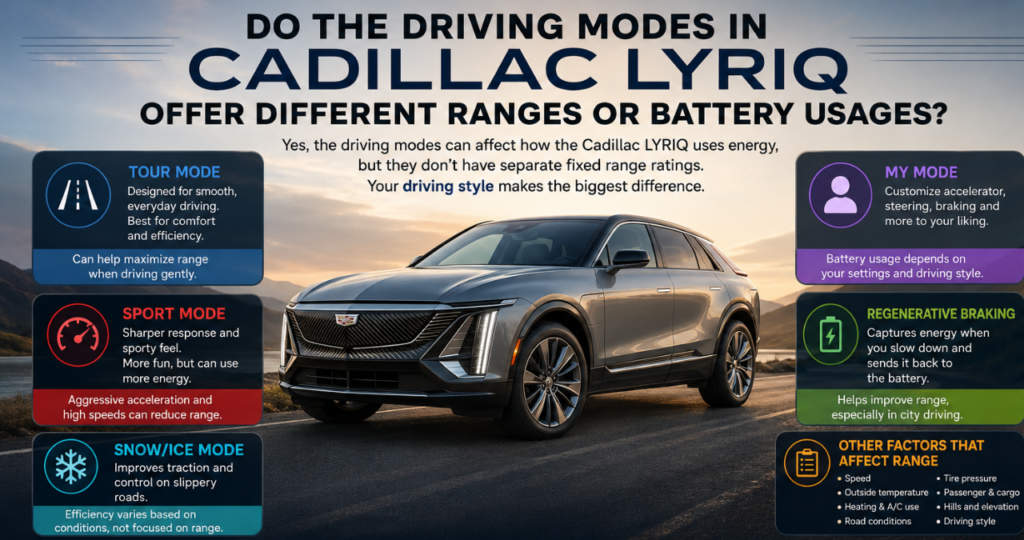
The short answer is yes, driving modes can indirectly affect range and battery consumption, but Cadillac doesn’t give each standard driving mode a separate fixed EPA range rating. Instead, the modes change how the LYRIQ responds to the accelerator, steering, braking, and other driving characteristics. Your actual range depends heavily on how you drive while using each mode.
Cadillac currently lists Tour, Sport, Snow/Ice, and My Mode among the LYRIQ’s available driving modes, although availability can vary by model and equipment. Tour is designed for everyday driving, while Sport gives the vehicle a more immediate and performance-focused feel. Snow/Ice is intended to improve control on slippery surfaces, and My Mode lets drivers personalize several driving characteristics.
Understanding these differences can help owners make better choices. After all, an EV is at its most useful when you know how to balance performance, comfort, and efficiency.
Understanding the Cadillac LYRIQ’s Electric Power System
Before comparing driving modes, it helps to understand what actually determines an EV’s range.
The LYRIQ uses GM’s Ultium battery platform. Current LYRIQ specifications list a 102-kWh battery capacity, while range varies according to the drivetrain and configuration. For example, current Cadillac specifications list up to 326 miles of EPA-estimated range for single-motor rear-wheel-drive LYRIQ models and up to 319 miles for certain dual-motor all-wheel-drive versions.
That range figure isn’t a promise that every driver will travel exactly that distance on a full charge. EPA estimates are laboratory-based comparison figures. Real-world results can be higher or lower depending on conditions.
Several factors influence electricity consumption:
- Vehicle speed
- Acceleration habits
- Outside temperature
- Heating and air conditioning
- Road surface
- Hills and elevation changes
- Tire pressure
- Wind
- Passenger and cargo weight
- Use of all-wheel drive
- Driving style
- Battery temperature
- Traffic conditions
The driving mode is therefore one piece of a much bigger puzzle.
How LYRIQ Driving Modes Actually Work
A driving mode doesn’t normally create a different battery pack or magically change the amount of electricity stored in the battery. Instead, it changes the way the vehicle’s systems respond to your inputs.
Cadillac describes the LYRIQ’s modes as tools for adapting performance and driving characteristics. Tour is tuned for smooth everyday driving. Sport provides a more immediate torque response and enhanced road connection. Snow/Ice is designed to help prevent wheel spin on slippery roads. My Mode allows certain characteristics to be customized.
This distinction is important.
Think of the battery as a large energy tank. The driving mode changes how aggressively or gently the vehicle uses that energy. If you select Sport and frequently accelerate hard, electricity can be consumed faster. If you select Tour and drive smoothly, consumption may be lower.
However, simply selecting Sport doesn’t necessarily mean the battery will drain at a fixed percentage per mile.
That’s because your right foot still plays a huge role.
Tour Mode: The Everyday Choice
Tour is the primary everyday driving mode for the LYRIQ. Cadillac says this mode is designed around a smooth ride and normal daily driving.
For many owners, Tour will probably be the easiest mode to use when efficiency and comfort are both priorities.
In everyday traffic, Tour can make the LYRIQ feel predictable and relaxed. Gentle accelerator inputs can also encourage a more measured driving style.
Why Tour May Help With Efficiency
Tour itself shouldn’t be thought of as a special “maximum range” mode. Instead, it provides a balanced driving setup.
When you combine Tour with sensible driving habits, you can potentially reduce unnecessary energy use.
Helpful habits include:
- Accelerating smoothly.
- Avoiding repeated hard launches.
- Maintaining a steady speed.
- Using regenerative braking appropriately.
- Avoiding unnecessary high-speed driving.
- Keeping tires properly inflated.
- Limiting excessive heating or cooling when practical.
The biggest advantage of Tour may therefore be behavioral and practical rather than a guaranteed battery-saving feature.
If your goal is to travel comfortably while making your charge last, Tour is a logical starting point.
Sport Mode: More Response Can Mean More Energy Use
Sport is where the question about battery usage becomes particularly interesting.
Cadillac describes Sport as providing a more immediate torque response and improved steering response at higher speeds.
Electric motors already produce strong, instant torque. When a vehicle is tuned to respond more aggressively, drivers may be tempted to use that performance more often.
That can increase energy consumption.
For example, imagine two LYRIQ drivers traveling the same 50-mile route. One uses Sport but drives gently, while the other uses Sport and repeatedly accelerates hard from traffic lights. Their energy consumption could be quite different.
In other words:
Sport mode doesn’t automatically consume a specific amount of extra battery energy. Aggressive driving in Sport mode is what can significantly increase consumption.
This is an important distinction.
Does Sport Mode Reduce Range?
Potentially, yes, in real-world use, particularly when it encourages faster acceleration and higher speeds.
But there isn’t a simple official rule saying, for example, “Sport mode reduces LYRIQ range by exactly 10 percent.” Such a number would be misleading because energy consumption varies with the driver and environment.
The effect can be especially noticeable during:
- Frequent hard acceleration
- High-speed highway driving
- Mountain roads
- Spirited cornering
- Stop-and-go traffic with repeated acceleration
So, if maximum range is your priority, Sport may not be the best setting for every journey.
On the other hand, if you enjoy the LYRIQ’s performance, Sport can make driving more engaging. That’s one of the benefits of owning an EV with strong electric-motor performance.
Snow/Ice Mode: Efficiency Is Not the Main Goal
Snow/Ice mode serves a different purpose.
Cadillac says this mode is intended to help prevent wheel spin and improve performance on slippery roads.
When roads are covered with snow, ice, or other slippery conditions, the priority isn’t necessarily maximum range. The priority is traction, control, and predictable acceleration.
The vehicle may modify how accelerator inputs translate into torque. This can make acceleration easier to manage on low-grip surfaces.
Can Snow/Ice Mode Use More Battery?
It depends on the situation.
If the mode helps prevent wheel spin and allows smoother progress, it could actually be beneficial compared with an inexperienced driver repeatedly spinning the tires or making abrupt inputs.
However, winter driving itself can reduce EV range.
Cold temperatures can affect battery performance, while cabin heating also requires energy. Snow-covered roads can increase rolling resistance, and winter tires may have different efficiency characteristics.
Therefore, if you see lower range in winter, don’t automatically blame Snow/Ice mode.
The weather may be the bigger factor.
My Mode: A Personalized Balance
My Mode is particularly useful for drivers who don’t want to choose between a completely relaxed setup and a sporty one.
Cadillac says My Mode allows drivers to personalize characteristics such as accelerator responsiveness, steering feel, braking responsiveness, and Electric Vehicle Sound Enhancement.
That flexibility means battery usage can vary depending on how you configure the vehicle and how you drive.
For example, a driver could create a setup with comfortable steering and moderate accelerator response. Another driver might choose a sharper accelerator response because they enjoy a sportier feeling.
My Mode doesn’t mean the LYRIQ suddenly receives a new EPA-rated range. Instead, it gives the driver more control over the vehicle’s behavior.
That’s a useful feature for people who know exactly how they like their EV to feel.
What About Regenerative Braking and Battery Usage?
Regenerative braking is another major part of the LYRIQ’s efficiency story.
Cadillac describes regenerative braking as a way to capture braking energy and add it back into the vehicle’s battery system. The LYRIQ also offers features such as One-Pedal Driving and Regen On Demand.
When you slow down, the electric motor can operate in a way that recovers some kinetic energy instead of allowing all of it to disappear as heat through conventional friction braking.
That doesn’t mean regeneration creates free energy.
There are energy losses throughout the process. Still, recovering some energy is valuable, particularly in urban driving.
City Driving Can Be Different From Highway Driving
This is where EVs can surprise new owners.
In city traffic, a vehicle repeatedly slows down and accelerates. Regenerative braking can recover some of the energy during deceleration.
On a highway, however, you may travel at a steady high speed with fewer opportunities for regeneration.
Air resistance also increases significantly as speed rises.
So, even though highway driving may feel easier mechanically, it can consume a lot of electricity.
This is another reason why driving mode alone doesn’t determine range.
Does the LYRIQ Show Energy Consumption?
Yes. Cadillac provides vehicle information features that can display information about energy usage and efficiency.
This is one of the best ways for an owner to learn how different driving habits affect the vehicle.
Instead of relying only on general advice, you can observe your own LYRIQ.
For example, you might compare:
| Driving Situation | Likely Energy Effect | Main Reason |
|---|---|---|
| Gentle Tour driving | Lower consumption potential | Smooth acceleration |
| Aggressive Sport driving | Higher consumption potential | Strong acceleration and higher speeds |
| Snow/Ice driving | Varies | Road conditions and traction needs |
| My Mode | Depends on settings | Driver-selected response |
| High-speed highway driving | Often higher | Increased aerodynamic resistance |
| Urban driving with regeneration | Can be favorable | Energy recovered during deceleration |
| Cold-weather driving | Often higher | Battery temperature and cabin heating |
| Heavy cargo | Higher | More weight to move |
This table shouldn’t be treated as a set of fixed percentages. Real consumption can change substantially from one trip to another.
Driving Mode vs. Actual Range: What’s the Difference?
One of the most common misunderstandings about EVs is confusing estimated range with energy consumption.
The LYRIQ’s advertised EPA range is an official testing estimate for a specific configuration. It isn’t a separate range number for every driving mode.
For example, Cadillac currently lists up to 326 miles of EPA-estimated range for certain RWD LYRIQ models. Dual-motor AWD models have different range figures.
That means drivetrain configuration can have a much clearer effect on official range than simply changing from Tour to Sport.
A Simple Example
Imagine a LYRIQ begins a trip with a full battery.
If the driver:
- Uses Tour
- Accelerates gently
- Drives at moderate speeds
- Avoids unnecessary climate-control use
- Maintains correct tire pressure
the vehicle may achieve relatively efficient energy use.
Now imagine another driver:
- Uses Sport
- Accelerates hard
- Drives at high speeds
- Carries additional weight
- Uses strong heating or cooling
The second driver may arrive at the destination with a lower state of charge.
The difference isn’t necessarily because Sport has a hidden “range penalty.” It’s largely because of how the vehicle is being driven.
Why Speed Matters More Than Many Drivers Expect
If you’re trying to maximize LYRIQ range, speed deserves special attention.
At higher speeds, aerodynamic drag becomes increasingly important. The vehicle has to work harder to push through the air.
This is true regardless of whether the vehicle is powered by gasoline or electricity.
However, EV drivers can see the effect clearly because their dashboard provides energy and range information.
A driver traveling at a moderate, steady speed may use considerably less energy per mile than someone driving aggressively at much higher speeds.
So, when comparing Tour and Sport, don’t overlook this point:
Your speed and acceleration habits can matter more than the name of the selected driving mode.
Does All-Wheel Drive Change the Equation?
Yes, drivetrain configuration matters.
Cadillac’s current specifications show different range figures for RWD and AWD LYRIQ models. For example, the current LYRIQ specifications list up to 326 miles for single-motor RWD and up to 319 miles for certain dual-motor AWD configurations.
An AWD vehicle has additional hardware and can deliver power through both axles when required. That can affect efficiency.
But AWD isn’t simply “bad for range.” It provides advantages in traction and performance.
If you’re driving on slippery roads, an AWD LYRIQ can provide a useful level of confidence and control.
The best choice depends on what you value most.
Weather Has a Major Impact on Battery Usage
It would be a mistake to blame driving modes for every change in range.
Temperature can have a major effect on an EV.
Cold weather can make battery operation less efficient, while cabin heating consumes electricity. Hot weather can also increase energy demand because air conditioning and thermal-management systems require power.
Winter roads can add another challenge.
Snow, slush, and wet pavement may increase resistance, while cold tires and winter tires can affect efficiency.
This means a LYRIQ that normally shows a strong range estimate may display a lower figure during a particularly cold period.
That’s normal EV behavior.
Heating and Air Conditioning Also Use Energy
The cabin is another part of the energy equation.
When you turn on heating or air conditioning, electricity is used to maintain a comfortable interior temperature.
This doesn’t mean you should avoid climate control. Safety and comfort matter. Instead, understanding the effect helps explain why two identical vehicles can show different energy consumption.
For longer trips, drivers can consider practical strategies such as:
- Preconditioning the vehicle while it is plugged in, when appropriate.
- Avoiding unnecessary extreme temperature settings.
- Using seat heating where available when it suits the conditions.
- Planning charging stops with weather conditions in mind.
These habits can complement an efficient driving mode.
Battery Usage Is Not the Same as Battery Damage
Another important point is that using Sport mode doesn’t automatically mean you’re damaging the LYRIQ’s battery.
Modern EV battery systems are designed to manage power, temperature, charging, and other operating conditions.
Performance driving can consume energy faster, but energy consumption and battery degradation are not the same thing.
Battery longevity is influenced by many factors, including temperature, charging behavior, battery management, age, and usage patterns.
The LYRIQ’s sophisticated battery system is designed to manage the battery as part of the vehicle’s overall powertrain.
For exact battery-care recommendations, owners should consult the specific Owner’s Manual for their model year. Cadillac provides manuals and guides by vehicle year and model.
How to Maximize LYRIQ Range in Everyday Driving
If your goal is to get the most distance from each charge, you don’t necessarily need to drive like you’re balancing a glass of water on the dashboard.
A few practical habits can make a difference.
Use Tour for Routine Trips
Tour provides a smooth, everyday-oriented setup, making it a sensible default for commuting and regular errands.
Accelerate Smoothly
Electric vehicles respond quickly, so it’s easy to accelerate harder than necessary. Smooth inputs can help reduce unnecessary energy use.
Maintain a Steady Speed
Frequent changes in speed generally require more energy than smooth, consistent driving.
Watch Highway Speeds
Higher speeds can have a noticeable effect on EV consumption because of aerodynamic resistance.
Use Regenerative Features Wisely
The LYRIQ’s regenerative braking features can help recover energy during deceleration.
Check Tire Pressure
Incorrect tire pressure can increase rolling resistance and reduce efficiency.
Pay Attention to Weather
If temperatures are extreme, expect real-world range to differ from ideal conditions.
Use Sport When You Want It
There’s no reason to avoid Sport simply because it can encourage higher energy consumption. That’s what the mode is there for. Enjoying the vehicle is part of the ownership experience.
The key is knowing that spirited driving may require more frequent charging.
A Practical Comparison of LYRIQ Driving Modes
| Mode | Main Purpose | Potential Effect on Energy Use | Best Use |
| Tour | Smooth everyday driving | Often favorable when driven gently | Commuting and normal trips |
| Sport | Faster response and sporty feel | Can increase consumption with aggressive driving | Enthusiastic driving |
| Snow/Ice | Better control on slippery surfaces | Depends heavily on conditions | Snow, ice and slippery roads |
| My Mode | Personalized driving setup | Depends on selected settings and driving style | Custom preferences |
These descriptions reflect the intended characteristics of the modes rather than guaranteed consumption results. Cadillac itself emphasizes that available modes can vary according to vehicle model and equipment.
What About the LYRIQ-V?
The performance-focused LYRIQ-V deserves separate attention.
Cadillac lists the LYRIQ-V as a dual-motor AWD performance EV. Current specifications list an EPA-estimated range of 285 miles and Cadillac-estimated output of up to 615 horsepower in its specified performance setting.
The LYRIQ-V also includes specialized performance features and V-Mode. Cadillac says V-Mode provides access to performance-oriented settings, including Launch Control and Competitive Mode on applicable models.
Naturally, using high-performance features can increase energy consumption.
That’s not a flaw. It’s simply the trade-off that comes with performance.
More power, faster acceleration, and spirited driving can require more electricity.
For a performance-oriented EV, that’s part of the package.
Common Misconceptions About LYRIQ Driving Modes
There are several myths worth clearing up.
Myth: Sport Mode Always Cuts Range by a Fixed Percentage
Not necessarily.
There isn’t a universal percentage that applies to every LYRIQ driver. Consumption depends on how Sport is used.
Myth: Tour Mode Guarantees Maximum Range
Not exactly.
Tour supports comfortable everyday driving, but weather, speed, road conditions, and driving behavior still matter.
Myth: Snow/Ice Mode Is Only About Saving Battery
No.
Its primary purpose is improved control on slippery surfaces. Safety and traction are more important than chasing a small efficiency difference.
Myth: Regenerative Braking Creates Free Electricity
No.
Regeneration recovers some energy that would otherwise be lost during deceleration, but energy conversion isn’t perfectly efficient.
Myth: A Lower Range Estimate Means Something Is Wrong
Not automatically.
Range estimates can change because the vehicle is continuously responding to recent driving conditions and energy consumption.
How Owners Can Test the Difference Themselves
If you’re curious about do the driving modes in Cadillac LYRIQ offer different ranges or battery usages?, one of the most useful approaches is to compare your own driving data.
Choose a familiar route and, where practical, repeat it under similar conditions.
For example:
- Drive the route in Tour.
- Keep your speed reasonably consistent.
- Record energy consumption.
- Repeat the route in Sport.
- Try to keep traffic and weather conditions similar.
- Compare the results.
The important part is controlling as many variables as possible.
If one test is performed on a hot day with strong wind and another on a cool, calm day, the results won’t provide a clean comparison.
This kind of real-world testing can teach you more about your own driving habits than a generic internet claim.
Why the Driver Still Matters Most
The LYRIQ is a sophisticated EV, but technology can’t completely overcome physics.
Hard acceleration uses more energy. High speeds require more energy. Cold temperatures can reduce efficiency. Heavy loads require more work.
The driving mode influences the vehicle’s behavior, but the person behind the wheel remains one of the biggest factors in energy consumption.
That’s actually good news.
It means drivers have significant control over their efficiency.
You don’t have to obsess over every mile of range. Simply driving smoothly and understanding how the vehicle responds can go a long way.
Charging Planning for Longer Trips
For road trips, it’s wise to think beyond the displayed range number.
Cadillac provides charging options for the LYRIQ, including Level 1, Level 2 and DC fast charging depending on configuration and equipment. Current LYRIQ specifications identify a 102-kWh battery platform and support for modern charging hardware.
When planning a long journey, consider:
- Starting with a suitable charge level.
- Checking charging locations along the route.
- Allowing for weather changes.
- Considering highway speeds.
- Keeping a reasonable charging buffer.
- Understanding that charging speed can vary with battery conditions and charger capability.
A little planning can turn an EV road trip from a source of anxiety into a smooth and enjoyable experience.
The Bigger Picture: Efficiency Without Giving Up Enjoyment
One of the best things about the LYRIQ is that efficiency and enjoyment don’t have to be enemies.
Tour can provide a relaxed daily experience.
Sport can make the vehicle feel more energetic.
Snow/Ice can help in challenging weather.
My Mode can give drivers a personalized setup.
The smart approach is to use the mode that matches the situation.
If you’re heading to work on a normal morning, Tour may make perfect sense. If you’re driving on a slippery road, Snow/Ice may be more appropriate. If you’re enjoying an open road and want sharper responses, Sport has a clear purpose.
In other words, there’s no need to treat every driving mode as a competition for the lowest possible electricity consumption.
Final Answer: Do the Driving Modes in Cadillac LYRIQ Offer Different Ranges or Battery Usages?
So, do the driving modes in Cadillac LYRIQ offer different ranges or battery usages? The most accurate answer is they can influence real-world energy consumption, but they don’t come with separate fixed range ratings in the way different battery or drivetrain configurations do.
Tour is designed for smooth everyday driving, and gentle driving in this mode can support efficient energy use. Sport provides quicker responses and can use more energy when it encourages stronger acceleration or higher speeds. Snow/Ice prioritizes traction and control rather than maximum range. My Mode allows drivers to customize the vehicle’s responses, so its energy effect depends on the chosen settings and driving style.
The most important lesson is that driving mode is only one factor. Speed, acceleration, weather, temperature, road conditions, tires, climate control, drivetrain, and regenerative braking all contribute to the LYRIQ’s actual electricity consumption.
For owners who want maximum range, smooth driving, moderate speeds, good tire maintenance, and sensible climate-control use are generally more important than simply leaving the vehicle in one particular mode.
And for drivers who want performance, there’s no need to feel guilty about using Sport. The LYRIQ was designed to offer both comfort and excitement. Just remember that performance comes with an energy cost.
Ultimately, do the driving modes in Cadillac LYRIQ offer different ranges or battery usages? Yes, they can affect how much electricity the vehicle uses in real-world driving, but there isn’t a simple mode-by-mode range number. The best results come from understanding what each mode is designed to do and matching it to the road, weather, and your driving style.
Join vantage here to receive the latest news and daily updates.Categories