
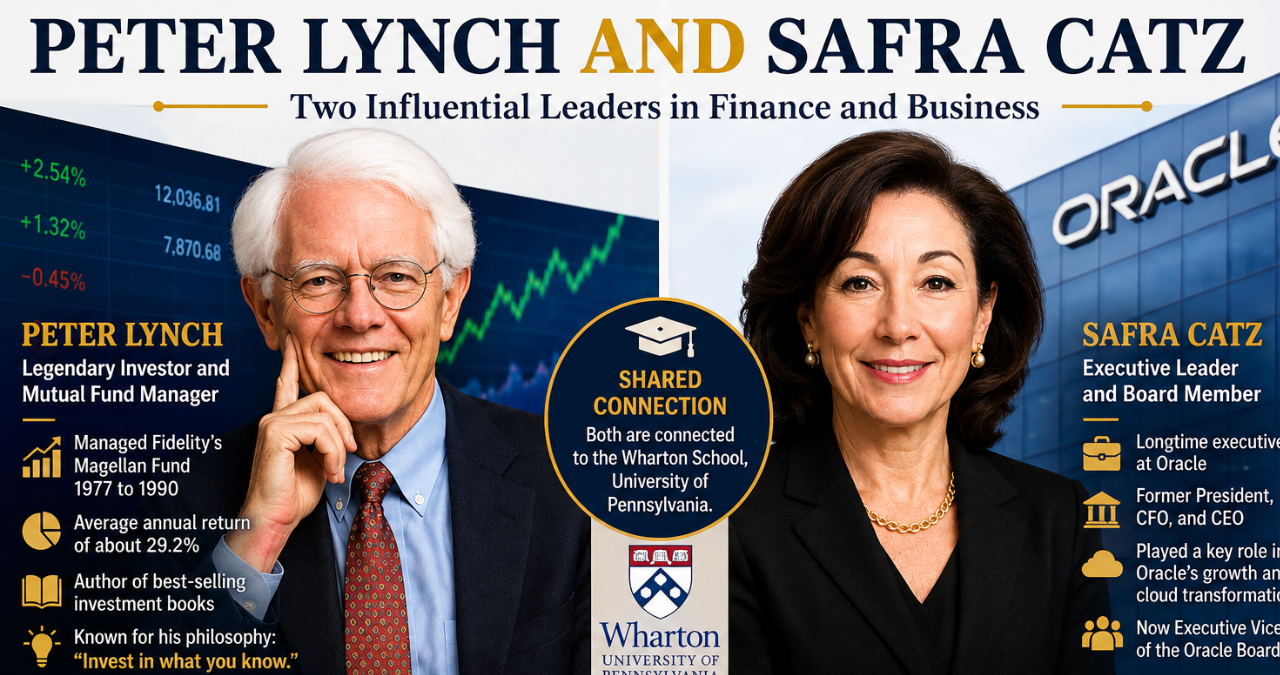
When people search for **peter lynch and safra catz **, they may wonder whether these two well-known names in finance and business have worked together or share a deeper professional connection. The answer is more interesting than it first appears. Peter Lynch and Safra Catz are both highly respected figures, but they built their reputations in very different ways.
Peter Lynch became famous as an investor and mutual fund manager. He is best known for managing Fidelity’s Magellan Fund from 1977 to 1990. During those years, he became one of the most recognized money managers in the world. His practical approach to investing made complex financial ideas easier for ordinary people to understand.
Safra Catz, on the other hand, built her career in investment banking and corporate leadership. She became a major figure at Oracle, where she served in several senior positions, including president, chief financial officer, and CEO. In September 2025, Oracle announced that Catz would become Executive Vice Chair of the Oracle Board after serving as CEO since 2014.
Although their careers are different, there is a notable educational link between them: both have a connection to the University of Pennsylvania’s Wharton School. However, available professional biographies do not establish a direct business partnership, family relationship, or investment collaboration between them.
Understanding **peter lynch and safra catz ** is therefore less about finding a hidden partnership and more about comparing two impressive approaches to finance, leadership, decision-making, and long-term success.
Who Is Peter Lynch?
Peter Lynch is one of America’s best-known investors. Born in 1944, he developed an interest in stocks at a young age and later joined Fidelity Investments. His early experience included researching several industries before he eventually became director of research and then manager of the Magellan Fund.
Lynch managed Magellan for 13 years, from 1977 until 1990. When he took control, the fund was relatively small. Over his time as manager, it grew dramatically and became one of the most successful mutual funds of its era. Sources including Wharton and the Museum of American Finance report an average annual return of about 29.2 percent during his management period.
What made Lynch special wasn’t simply his investment record. He also had a gift for explaining financial ideas in plain language. Instead of making investing sound mysterious, he encouraged people to pay attention to businesses they already understood.
His well-known investment philosophy is often summarized through the idea of investing in what you know. In practical terms, this means that everyday experiences can sometimes help investors notice successful companies before they become widely recognized by Wall Street.
Lynch later became an author and philanthropist. His books, including One Up on Wall Street, Beating the Street, and Learn to Earn, helped introduce generations of readers to stock-market concepts.
Who Is Safra Catz?
Safra Catz is a prominent business executive whose career has combined finance, investment banking, technology, and corporate management.
Before joining Oracle, Catz worked at Donaldson, Lufkin & Jenrette, where she held senior investment-banking positions. She later became one of Oracle’s most influential executives. Oracle’s official biography states that she previously served as president, chief financial officer, executive vice president, and senior vice president.
Catz joined Oracle’s board in 2001 and became president in 2004. She became CEO in 2014 and shared the company’s top executive role for periods during Oracle’s leadership transition. Her work was closely connected with corporate finance, acquisitions, operations, and business strategy.
In September 2025, Oracle announced a major leadership change. Clay Magouyrk and Mike Sicilia were promoted to CEO roles, while Catz became Executive Vice Chair of the Oracle Board. Oracle said that Catz had helped lead the company as it developed into a major cloud technology business.
As of 2026, Oracle’s official board page lists Safra Catz as Executive Vice Chair of the Oracle Board of Directors.
Peter Lynch and Safra Catz: What Is the Connection?
The phrase **peter lynch and safra catz ** can suggest that the two people have a direct professional relationship. However, reliable biographical information does not show that they were business partners, colleagues, investment advisers, or members of the same corporate leadership team.
Their strongest documented connection is educational.
Both have a Wharton connection at the University of Pennsylvania. Lynch earned his MBA from Wharton in 1968. Wharton identifies him as WG’68 and highlights his remarkable investment career at Fidelity’s Magellan Fund.
Catz also studied at the University of Pennsylvania and attended Wharton before completing her law degree at the university. Her academic and professional background helped prepare her for a career that blended finance, law, investment banking, and corporate management.
This shared educational connection is interesting, but it should not be overstated. They attended during different periods, and there is no reliable evidence that they were classmates or that their careers were built through a personal partnership.
In other words, the relationship between **peter lynch and safra catz ** is best understood as a comparison between two accomplished financial leaders who traveled different roads.
Their Careers Took Different Paths
One of the easiest ways to understand these two figures is to compare what they were responsible for.
Peter Lynch primarily worked on the investment side of finance. His job was to study businesses and decide where a mutual fund should invest its money.
Safra Catz primarily worked on the corporate side. Her responsibilities involved helping manage a huge technology company, making strategic decisions, overseeing financial matters, and supporting Oracle’s growth.
The difference can be summarized like this:
| Area | Peter Lynch | Safra Catz |
|---|---|---|
| Main field | Investment management | Corporate leadership |
| Best known for | Managing Fidelity Magellan Fund | Leadership at Oracle |
| Major organization | Fidelity Investments | Oracle |
| Key role | Portfolio manager | Executive and board leader |
| Investment focus | Selecting companies and stocks | Managing corporate capital and strategy |
| Famous for | Long-term stock selection | Finance, strategy, acquisitions, and operations |
| Education connection | Wharton MBA | University of Pennsylvania and Wharton |
| Writing | Authored investment books | Known primarily for executive leadership |
| Leadership style | Research-driven investing | Strategic corporate management |
This comparison shows why putting **peter lynch and safra catz ** side by side can be useful. They demonstrate two different ways that financial knowledge can be applied.
Peter Lynch’s Investment Philosophy
Peter Lynch’s investment ideas remain popular because they are relatively easy to understand.
His philosophy encouraged investors to look beyond complicated market predictions and study actual companies. He believed that ordinary consumers could sometimes notice useful trends in daily life.
For example, someone might notice that a particular restaurant is constantly busy, a certain retailer is expanding quickly, or a product has become extremely popular. That observation alone isn’t enough to justify buying a stock, but it can encourage further research.
Lynch’s approach involved examining the company’s:
- Earnings
- Growth prospects
- Debt
- Business model
- Competitive position
- Valuation
- Management
- Industry conditions
His record at Magellan made the philosophy famous. During his 1977–1990 management period, the fund produced an average annual return of approximately 29.2 percent, according to Wharton and other authoritative sources.
Still, Lynch’s success shouldn’t be misunderstood as a promise that investors can easily reproduce those results. Markets are uncertain, and past performance doesn’t guarantee future returns.
The deeper lesson is that good investing requires research, patience, and discipline.
Safra Catz’s Approach to Corporate Leadership
Safra Catz operates in a very different environment.
Instead of selecting stocks for a mutual fund, she has spent much of her career helping manage one of the world’s largest technology companies. That requires decisions involving financial performance, acquisitions, technology investment, employees, customers, competition, and long-term strategy.
Her background in investment banking gave her experience in understanding businesses and financial transactions. At Oracle, those skills became part of a broader executive role.
Corporate leadership can require answering questions such as:
- Which businesses should the company acquire?
- How should the company invest its resources?
- How can revenue growth be maintained?
- What technologies should receive funding?
- How can a company compete in changing markets?
- How should financial risks be managed?
- How can long-term opportunities be balanced with short-term demands?
Catz’s Oracle career became especially important as the company expanded its cloud business. Oracle’s 2025 leadership announcement credited her with helping guide the company during its development into a major cloud technology provider.
This illustrates an important difference between **peter lynch and safra catz **: Lynch studied companies from the perspective of an investor, while Catz helped run a company from inside its leadership structure.
The Importance of Wharton in Their Stories
Education is one of the most interesting points when discussing **peter lynch and safra catz **.
Wharton has a long history of producing leaders in finance, business, government, and entrepreneurship. For both Lynch and Catz, their connection to the University of Pennsylvania became part of a larger professional journey.
Lynch’s Wharton MBA helped strengthen his business and financial education before he returned to Fidelity and developed his career as an investment professional. Wharton later recognized his achievements and described him as a famous stock picker whose “invest in what you know” philosophy influenced investors around the world.
Catz’s University of Pennsylvania education similarly became part of her foundation for a career combining finance and law. She later moved into investment banking and eventually became a senior leader at Oracle.
Their stories demonstrate that education can provide useful tools, but education alone doesn’t create success. Experience, discipline, curiosity, judgment, and the ability to adapt are also important.
How Peter Lynch Changed the Way People Think About Investing
Before and during Lynch’s rise, many ordinary investors viewed Wall Street as a world controlled mainly by professionals.
Lynch helped challenge that idea.
His writing made stock-market concepts more approachable. He encouraged people to study companies rather than simply follow headlines or attempt to predict every market movement.
His investment philosophy also emphasized the importance of understanding the difference between a good company and a good investment. A strong business can still be overpriced, and a struggling business can sometimes be undervalued.
That distinction is important for students and new investors because it teaches a broader lesson: a good product does not automatically mean a good stock.
Lynch’s career also showed the importance of doing homework. His success wasn’t based simply on walking into a store, liking a product, and immediately buying shares. Everyday observations could generate ideas, but financial research was still necessary.
His career remains an important case study in long-term investing and disciplined analysis.
How Safra Catz Influenced Modern Corporate Leadership
Safra Catz’s career represents another side of modern finance.
Technology companies operate in a fast-changing environment. Cloud computing, artificial intelligence, cybersecurity, enterprise software, and data management have become major areas of competition.
Leading a technology corporation therefore requires more than traditional accounting knowledge. Executives must understand markets, technology, customers, investment decisions, and organizational change.
Catz’s long career at Oracle shows how financial expertise can become a powerful part of corporate strategy.
Oracle’s 2025 announcement also demonstrated a modern leadership principle: successful organizations need to prepare for the next generation. Catz said the company was in a strong position when she handed the CEO role to the next generation of leaders.
That transition is worth studying because leadership isn’t only about holding the top position. It can also involve building systems and teams that continue to perform after leadership changes.
Comparing Their Leadership Styles
Although direct comparisons should be made carefully, their professional roles reveal useful differences.
Peter Lynch: The Research-Oriented Investor
Lynch’s work depended heavily on research and judgment. He had to examine large numbers of companies and decide which ones appeared attractive.
His approach valued:
- Curiosity
- Patience
- Detailed research
- Independent thinking
- Long-term focus
- Understanding businesses
Safra Catz: The Strategic Executive
Catz’s work has required a broader corporate perspective.
Her career has involved:
- Financial management
- Corporate strategy
- Investment banking
- Acquisitions
- Technology business
- Executive leadership
- Board governance
Both careers demonstrate that financial expertise isn’t limited to buying and selling stocks. It can also help leaders make major decisions inside large organizations.
Their Views of Risk Would Be Different
Risk is another area where the careers of **peter lynch and safra catz ** can be compared.
An investor like Lynch faces portfolio risk. If a company performs badly, the investment can lose value. A fund manager therefore needs to spread risk, study businesses, and make decisions based on available information.
A corporate executive like Catz faces organizational risk. A technology company can lose customers, invest too much money in the wrong project, fall behind competitors, or experience difficulties with major acquisitions.
Both types of leaders need to ask similar basic questions:
What could go wrong?
But the answers can be very different.
For an investor, the question may involve stock valuation and business performance. For a corporate executive, it may involve billions of dollars in technology investments, strategic projects, employees, customers, and long-term competitiveness.
This is why financial leadership requires both numbers and judgment.
Lessons Students and Young Professionals Can Learn
The stories of **peter lynch and safra catz ** offer several useful lessons for people who are still building their careers.
Learn the Basics
Strong careers usually begin with strong foundations. Understanding accounting, economics, business, communication, and mathematics can open many doors.
Stay Curious
Lynch’s career shows the value of asking questions about businesses. Catz’s career shows the value of understanding changing industries.
Curiosity can turn an ordinary observation into a useful idea.
Think Long Term
Both investment and corporate leadership require long-term thinking.
Markets move up and down. Technology changes rapidly. A strong leader must avoid making every decision based on today’s headlines.
Develop Multiple Skills
Catz’s career demonstrates the value of combining financial knowledge with legal, managerial, and strategic skills.
Lynch’s career similarly shows how research, communication, and financial analysis can work together.
Don’t Follow the Crowd Blindly
One of Lynch’s important lessons was independent research. Investors shouldn’t buy something simply because everyone else is buying it.
The same idea applies to careers. Following trends can be useful, but understanding why something matters is even more valuable.
Common Misunderstandings About Peter Lynch and Safra Catz
Because their names are sometimes searched together, readers may assume there is a direct relationship.
That assumption should be treated carefully.
There is no reliable evidence in the authoritative biographies reviewed here showing that Lynch and Catz were business partners, worked at the same company, or maintained a documented professional relationship.
Their connection is primarily interesting because both became successful figures in finance and business and both have a Wharton connection.
It is also important not to confuse their professional roles. Peter Lynch was an investor and fund manager. Safra Catz became a corporate executive and board leader.
This distinction makes the topic clearer and prevents online speculation from being presented as established fact.
Peter Lynch’s Legacy Beyond Investing
Lynch’s influence extends beyond his years at Magellan.
He became a widely read author and teacher of investing concepts. His books helped ordinary readers understand terms and ideas that can otherwise seem intimidating.
He also devoted significant attention to philanthropy. The Museum of American Finance notes his long involvement with education and charitable causes, including scholarship work through the Lynch Foundation.
This part of his life is sometimes overlooked when people focus only on investment returns.
A person’s legacy isn’t always measured by money. Teaching, mentoring, and helping others can be equally meaningful.
Safra Catz’s Legacy at Oracle
Catz’s Oracle career is similarly larger than a job title.
She held several senior roles over many years and became closely associated with the company’s financial and strategic direction. Oracle’s official biography lists her previous positions as president, CFO, executive vice president, and senior vice president.
Her move from CEO to Executive Vice Chair in 2025 marked an important transition in Oracle’s leadership.
Oracle continues to list Catz as Executive Vice Chair of its board, while Clay Magouyrk and Mike Sicilia serve as CEOs.
Her career offers a strong example of how someone with financial expertise can move into the highest levels of corporate management.
What Their Stories Say About Success
When we compare **peter lynch and safra catz **, the most valuable lesson may be that there isn’t just one path to success.
Lynch became successful by studying businesses and investing capital.
Catz became successful by helping manage and grow a major technology corporation.
One worked mainly from the investor’s seat. The other worked mainly from the executive seat.
Yet both careers required qualities that are useful almost everywhere:
- Hard work
- Education
- Strong judgment
- Financial understanding
- Communication
- Persistence
- Adaptability
- Long-term thinking
That’s an important point for young readers. A successful career doesn’t have to copy somebody else’s career. Instead, people can take useful lessons from different leaders and build a path that fits their own strengths.
Why This Comparison Still Matters Today
The business world continues to change rapidly. Artificial intelligence, cloud computing, digital services, global markets, and new financial technologies are creating opportunities and risks.
Lynch’s lessons about studying businesses remain useful because investors still need to understand what companies actually do.
Catz’s career remains relevant because technology companies still need strong financial and strategic leadership.
The tools may change, but the basic questions remain familiar:
- Is the business creating real value?
- Does the company have a sustainable advantage?
- Are leaders making responsible decisions?
- Is growth supported by strong fundamentals?
- What risks could change the picture?
- Can the organization adapt to new conditions?
These questions connect the worlds of investing and corporate management.
Final Thoughts on Peter Lynch and Safra Catz
The story of **peter lynch and safra catz ** is not primarily a story of two people working together. Instead, it is a fascinating comparison between two influential careers connected by finance, business education, and leadership.
Peter Lynch became famous for managing Fidelity’s Magellan Fund and for explaining investing in a way that ordinary people could understand. His 1977–1990 record at Magellan, including an average annual return of about 29.2 percent, established him as one of the most successful fund managers of his generation.
Safra Catz built a different kind of legacy. Her journey from investment banking to senior leadership at Oracle shows how financial knowledge can be used to guide a global technology company. After serving as Oracle’s CEO from 2014, she became Executive Vice Chair of the board in 2025.
Their shared Wharton connection adds an interesting educational link, but there is no strong evidence of a direct professional partnership between them.
Ultimately, **peter lynch and safra catz ** represent two sides of modern financial leadership: one focused on identifying value from the investor’s perspective and the other focused on creating and managing value from inside a major corporation. Their careers remind us that success comes from knowledge, discipline, thoughtful decisions, and the courage to keep learning.
For anyone interested in investing, business, or leadership, studying both careers can be worthwhile. Their paths are different, but together they show just how broad and powerful the world of finance can be.
Join vantage here to receive the latest news and daily updates.Categories